
Financial Trauma Help
Healing from Finacial Trauma
A recorded class for understanding why money can feel so loaded, and how to build more room, more choice, and more self-trust.
You can know what you are “supposed” to do with money and still find yourself avoiding, freezing, overthinking, controlling, spending quickly, saving endlessly, or feeling like every financial decision carries far more weight than it should.
That does not automatically mean you need more discipline.
Sometimes it means money has learned to feel unsafe.
This class is about understanding what those responses may be doing for you now… without putting yourself on trial.
Recorded class • Educational • Shame-free • Go at your own pace
Sometimes the numbers are not the whole problem.
Money is connected to food, shelter, health, freedom, belonging, family, power, identity, time, and the future.
So it makes sense that financial experiences can leave behind responses that are much bigger than the math.
Maybe you avoid opening the banking app even when you know there is probably nothing catastrophic waiting.
Maybe a small purchase creates a full-body wave of shame.
Maybe having money does not make you feel safer.
Maybe you become highly controlling when things feel uncertain.
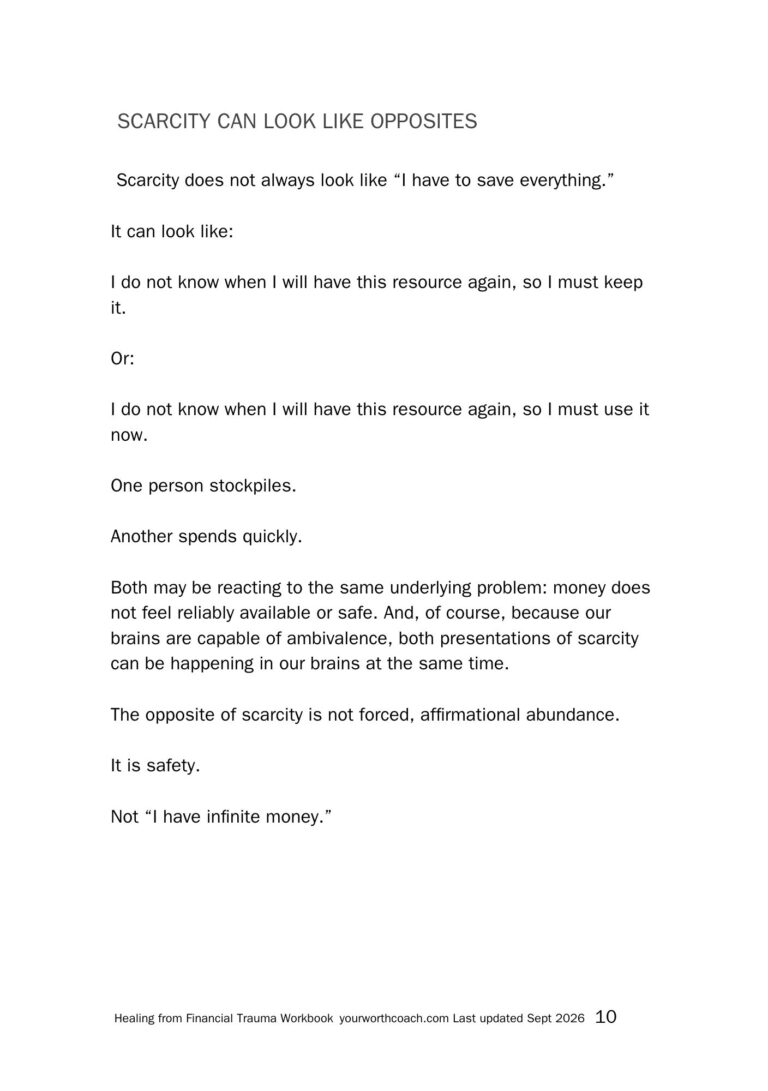
Maybe you spend quickly because holding onto money feels uncomfortable.
Maybe you can make excellent financial decisions for everyone else and completely lose access to that same clarity when the decision is yours.
These responses are not proof that you are irresponsible.
They are information.
The question is not “What is wrong with me?” The question is “What might this response be trying to do?”
Financial trauma does not have to look dramatic from the outside.
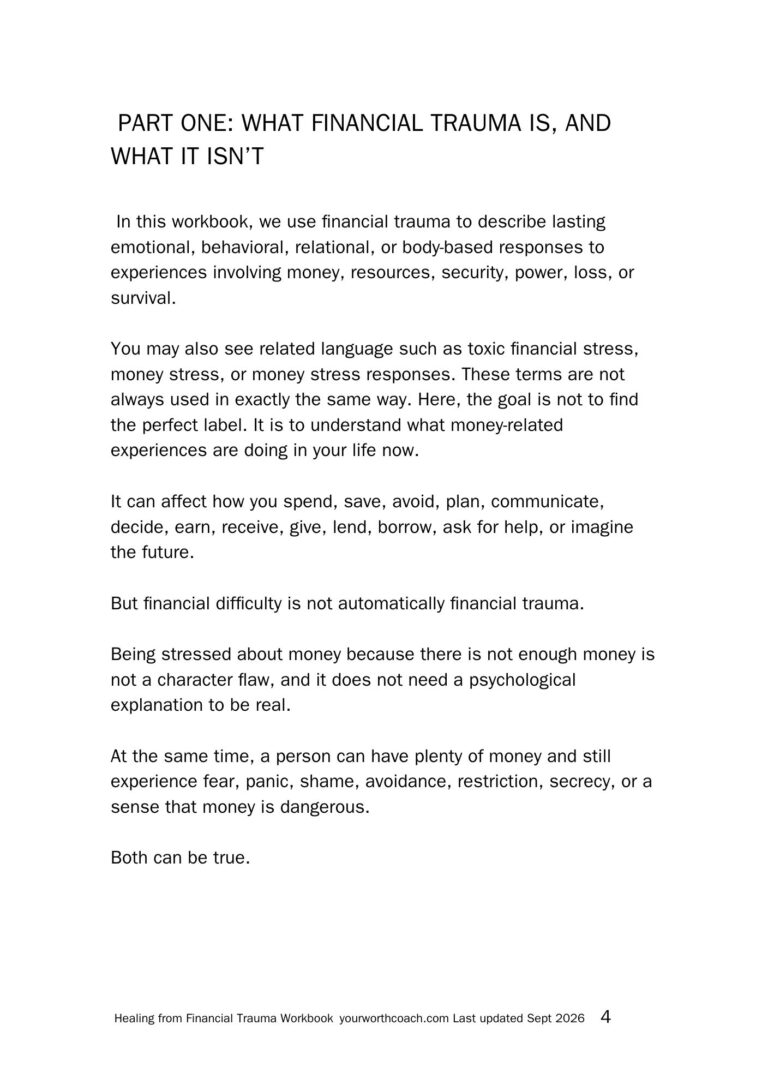
In this class, I use financial trauma to describe lasting emotional, behavioral, relational, or body-based responses to experiences involving money, resources, security, power, loss, or survival.
Sometimes the source is obvious:
poverty, job loss, foreclosure, medical debt, divorce, financial abuse, fraud, sudden loss, caregiving crises, or years of instability.
Sometimes it is quieter:
money was always tense in your family.
Help came with strings attached.
Mistakes were punished.
You were expected to rescue other people.
You were excluded from financial decisions.
You learned that wanting more made you selfish.
Or you repeatedly encountered systems that made you feel like you were the problem.
Sometimes there is no single event to point to.
You may also see related language such as toxic financial stress, money stress, or money stress responses. The goal here is not to find the perfect label.
The goal is to understand what money-related experiences are doing in your life now.
"I'm bad with money" behaviors all make more sense when we ask what they are trying to protect.
Avoidance, control, urgency, perfectionism, fixing, appeasing, overspending, underspending, hoarding, and procrastination can all make more sense when we ask what those behaviors are trying to protect, not if we’re failures for using them.
A money response can be frustrating and still be protective.
It can create problems and still have a job.
It can be outdated and still make sense.
In the class, we will look at these responses not as evidence against you, but as a scientist observing a wild animal:
What sets this off?
What happens next?
What does this response seem to be protecting?
What does it cost now?
What helps it settle enough for more choice to come back online?
Observation instead of judgment. Curiosity instead of prosecution.
You can care deeply about your financial life without living inside constant worry.
Worry often feels active, but it can be strangely immobilizing.
It loops.
It isolates.
It rehearses catastrophe.
It makes every decision feel urgent.
And it can convince us that if we stop worrying, we will stop caring.
Care behaves differently.
Care gathers information.
Care asks what matters.
Care notices capacity.
Care makes one choice at a time.
Care allows support.
This class does not ask you to magically“stop worrying.” ::eyeroll::
Instead, we will practice noticing the difference and creating a little more room to move between states.
Not calm.
Choice.
Feeling better is useful. It is not the only measure of progress.
You may still feel worried and have more choice.
You may still dislike a financial task and be able to approach it.
You may still feel activated and recover faster.
You may notice the pattern ten minutes sooner than you used to.
You may ask for help before things become a crisis.
You may make one decision without needing it to prove anything about your worth.
That counts.
The goal is not to produce the correct feeling.
The goal is more room around what you feel, more information about what is happening, and more options for what you do next.
Not confidence. Capacity.Not control. Safety. Not perfection. Enough information.
Wanting to do something and having the capacity to do it are not the same thing.
You can desperately want to deal with a financial task and still not have enough capacity for it today.
That is different from laziness.
Different from lack of motivation.
Different from not caring.
In the class, I use a simple +5/-5 framework to look at desire and capacity separately.
You may have:
high desire and low capacity,
low desire and high capacity,
or both moving around from day to day.
That gives us a much better question than “Why can’t I just make myself do it?”
We can ask:
How could I make this smaller?
Shorter?
Better supported?
Less threatening?
More compatible with the capacity I actually have?
Build capacity. Don’t apply more force.
You do not have to start with the hardest financial task in the room.
If opening your banking app feels like a ten-out-of-ten task, the answer is not necessarily to white-knuckle through it.
Maybe the experiment is opening the app and immediately closing it.
Maybe it is looking at one number.
Maybe it is writing down the name of the task without doing it.
Maybe it is sitting next to someone you trust while you look.
Maybe it is deciding, “Not this one today.”
Small does not mean unserious.
Small can be how your system learns:
I approached this.
Nothing terrible happened.
I still had choices.
I can trust myself to try again.
You do not have to start with the hardest financial task in the room.
If opening your banking app feels like a ten-out-of-ten task, the answer is not necessarily to white-knuckle through it.
Maybe the experiment is opening the app and immediately closing it.
Maybe it is looking at one number.
Maybe it is writing down the name of the task without doing it.
Maybe it is sitting next to someone you trust while you look.
Maybe it is deciding, “Not this one today.”
Small does not mean unserious.
Small can be how your system learns:
I approached this.
Nothing terrible happened.
I still had choices.
I can trust myself to try again.
Sometimes the story makes sense long after the situation has changed.
Money stories are not just beliefs we can replace with better slogans.
They often carry protection.
That is why I use S.P.A.C.E.™:
Story: What story or narrative did I learn about money?
Protection: What is this story trying to protect me from?
Aftermath: What is following this story costing me now?
Connection: Who could I safely share my story with?
Expansion: What would my life look like if that original story wasn’t driving me?
The goal is not to force a positive belief.
The goal is to understand why the story exists and create more room around it.
The companion workbook gives you a deeper S.P.A.C.E. exercise if you want to work directly with one of your own money stories.
Inside the class, we’ll explore:
- What financial trauma and money stress responses can look like
- Why opposite behaviors can come from similar experiences
- Protective money responses and the jobs they may be doing
- Worry versus Care
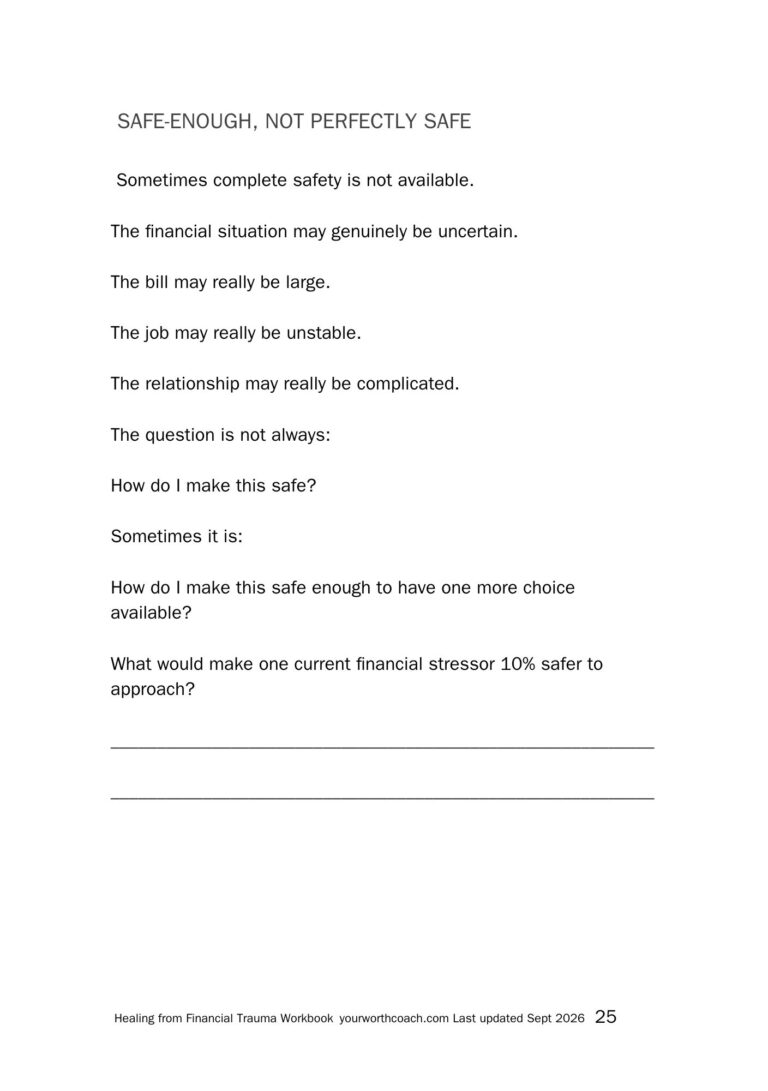
- Safe-enough approaches to financial tasks
- Why smaller experiments can create more useful learning
- Capacity Instead of Force
- Shame, punishment, restriction, perfectionism, and urgency
- How money stories can continue protecting us long after circumstances change
- Why healing is not the same as becoming perfectly calm
- How more choice, recovery, information, and self-trust can become meaningful measures of progress
This class is educational. It is not a diagnosis or treatment program.
This class may be useful if…
- Money feels unusually loaded, threatening, shameful, or exhausting
- You avoid financial tasks even when you know what to do
- You swing between avoidance and being controling
- Financial mistakes feel like evidence about your worth
- Having “enough” money does not reliably make you feel secure
- You overthink purchases or decisions long after the stakes justify it
- Restriction makes you feel trapped rather than safe
- Money conversations trigger defensiveness, shutdown, fixing, anger, or appeasing
- You struggle to imagine a financial future
- You want to understand your responses without diagnosing or shaming yourself
You do not need to decide whether your past financial experienes were “bad enough.”
You do not need to identify one dramatic event.
And you do not need to disclose painful experiences in order to use what you learn here.
Understand the pattern. Then work with your own
Use the class to understand the framework: why financial experiences can keep showing up in the present, what protective responses may be doing, and what progress can look like without demanding perfect calm.
Watch the recorded class
About 60 minutes. Watch at your own pace. No public participation or comment required.
This class was recorded. Any participant material included here is shared with permission.
Healing from Financial Trauma- Workbook
Use the 12-part workbook to explore your own responses, capacity, money stories, choices, support, and self-trust at your own pace.
Includes:
- Money Approach Ladder
- +5/-5 Desire & Capacity
- Full S.P.A.C.E.™ exercise
- Values / Risks / Any Other Way
- Self-trust experiment
- Support map
- Personal Financial Trauma Field Guide
Price:
$39
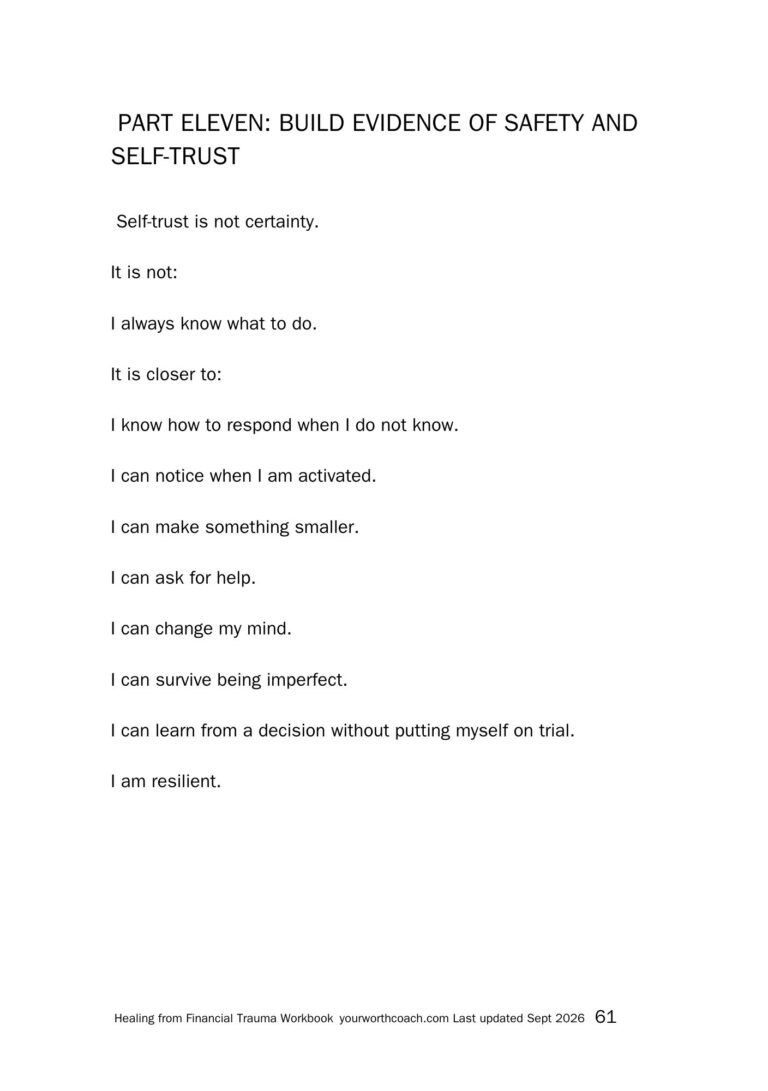
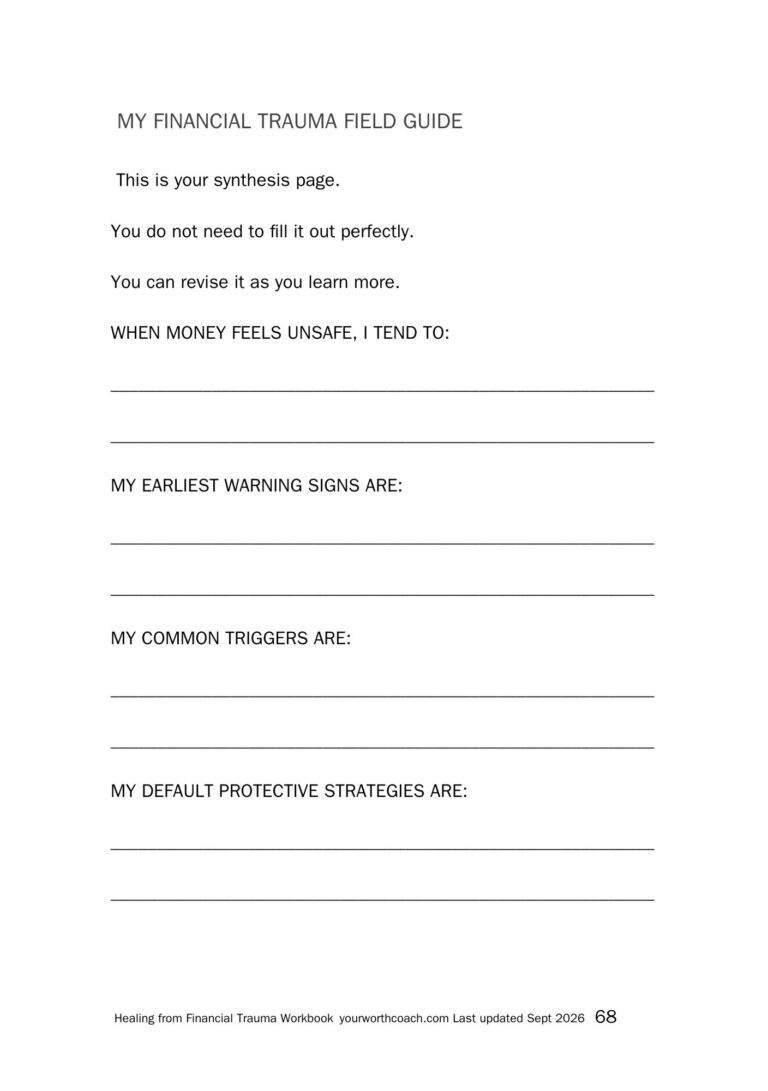
Pair the recorded class with the workbook so you can learn the approach and then work with it in your own life.
The goal is not to make you better at obeying financial rules.
A lot of money advice assumes that if you understand the numbers, the rest is discipline.
But people do not experience money as a spreadsheet.
We experience it through bodies, relationships, histories, systems, expectations, losses, hopes, and the stories we learned about what money means.
So the approach here is different:
Safety instead of control.
Choice instead of coercion.
Capacity instead of force.
Observation instead of judgment.
Curiosity instead of prosecution.
Support instead of punishment.
You are still allowed to use practical financial tools.
The question is whether the tool fits into YOUR life, not wether you can fit yourself into the tool.
A note about scope
This class is educational.
It does not diagnose trauma, PTSD, anxiety, ADHD, addiction, or any other medical or mental-health condition.
It is not therapy or financial, legal, tax, medical, or mental-health advice, and it is not a substitute for professional care.
If your financial situation includes coercion, threats, intimidation, financial control, abuse, acute crisis, or circumstances where safety is at risk, a workbook or recorded class may not be the right first tool. Consider reaching out to an appropriate qualified professional or support resource.
A few reasonable questions
Q: Do I need to have experienced a major financial crisis for this class to apply to me?
No. Some financial trauma comes from obvious crises. Some develops through chronic stress, family dynamics, instability, shame, power, restriction, exclusion, or repeated experiences that taught your system that money was not safe.
Q: Is this therapy?
Nope. This is an educational class. It can help you understand patterns and give you language and tools to work with them, but it does not diagnose or treat mental-health conditions.
Q: Is this about learning to budget?
Not primarily. Practical financial tools are useful, and an imporant part of financial health, but this class focuses on the relationship and protection side of money. A budgeting tool is not always the right tool for a relationship concern.
Q: Do I have to revisit painful memories?
No. You do not need to disclose or excavate traumatic experiences to get value from the workbook and class. The emphasis is on noticing what is happening now and building more choice around it.
Q: What if I still feel anxious after the class?
That does not mean the class failed. Feeling calmer can be useful, but progress may also look like approaching something you used to avoid, recovering faster, noticing a pattern sooner, asking for help, or having more options while anxiety is still present.
Q: Is the workbook included?
The workbook is a separate $39 companion resource designed for deeper self-guided practice.
Q: Can I start with the workbook instead?
Absolutely. The workbook stands on its own. The class offers more explanation and context; the workbook gives you more space to apply the ideas directly to your own life
You do not need to become fearless around money.
You do not need to erase your history.
You do not need to prove that you can finally “handle it.”
You can understand what is happening.
You can make things smaller.
You can build capacity.
You can create more room around what you feel.
And you can practice having more choices about what happens